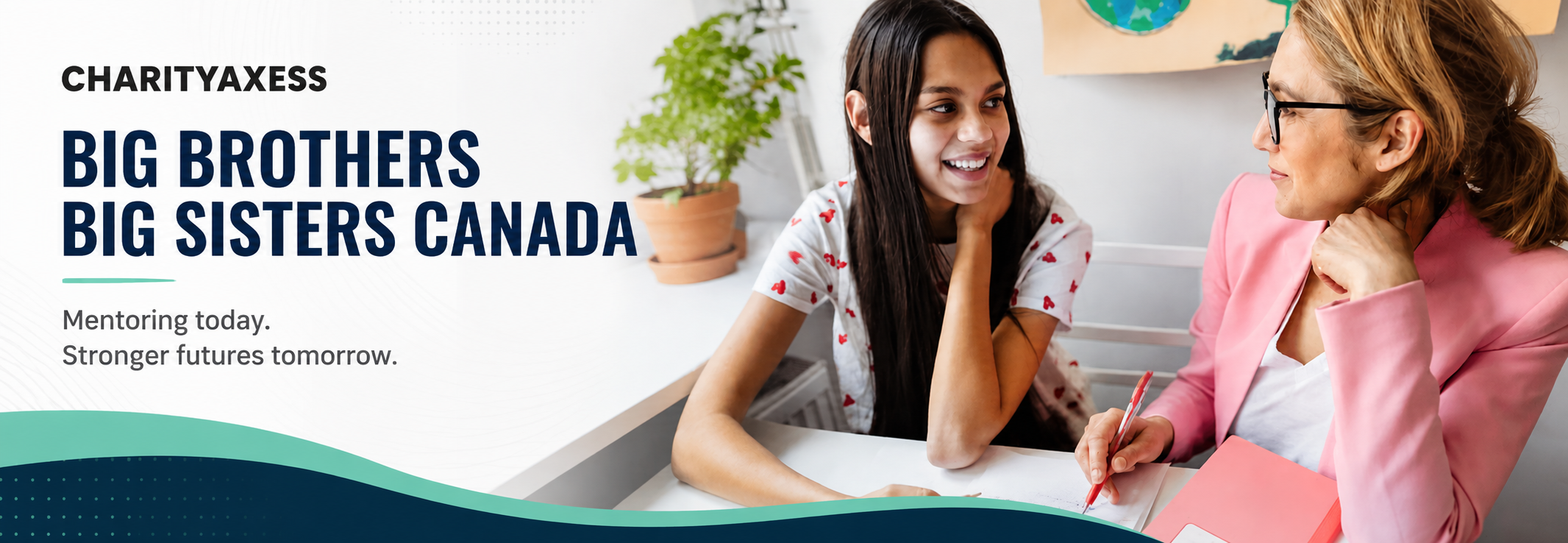
Big Brothers Big Sisters of Canada (BBBSC) is a national organization supporting children and youth through mentoring relationships delivered by local Big Brothers Big Sisters agencies across Canada. In 2025, the organization reported that 31,329 children and youth participated in mentoring programs supported by 17,871 volunteer mentors.
From one-to-one mentoring and school-based programs to group mentoring and programs for youth waiting to be matched, Big Brothers Big Sisters offers different ways for young people to build supportive relationships with mentors.
CharityAxess created this FAQ as part of its guide to Big Brothers Big Sisters in Canada, answering common questions about the organization, including how mentoring works, who the programs serve, volunteering, costs and the impact of mentorship.
What is Big Brothers Big Sisters?
Big Brothers Big Sisters is a youth mentoring organization that connects children and youth with mentors who provide consistent support, encouragement and guidance.
Big Brothers Big Sisters of Canada operates as a national federation, with local agencies delivering mentoring programs in communities across Canada. The national organization also supports agencies with areas such as program quality, child safety, training, marketing and national partnerships. In 2025, more than 31,000 children and youth participated in mentoring programs across the federation.
Learn more about Big Brothers Big Sisters of Canada, including its programs, services and impact, on CharityAxess.
What does Big Brothers Big Sisters do?
Big Brothers Big Sisters provides mentoring programs that help young people develop supportive relationships with mentors.
Programs include community-based one-to-one mentoring, site or school-based one-to-one mentoring, group mentoring and other programs, including services for some youth who are waiting to be matched.
Local agencies adapt their programs to the needs of the communities and young people they serve.
How does Big Brothers Big Sisters mentoring work?
Big Brothers Big Sisters agencies recruit and support mentors and connect them with young people based on program requirements and the needs of participants.
The organization says local agencies track the needs of children during enrolment through a Needs Registry. Agencies use this information to better understand participants' needs and help match young people with mentors who can support them.
Depending on the program, mentoring may take place in the community, at school, individually or in a group.
What is a “Big” and a “Little”?
Within Big Brothers Big Sisters, mentors are commonly referred to as Bigs, while children and youth participating as mentees are referred to as Littles.
The mentoring relationship, or match, is at the centre of Big Brothers Big Sisters programming. The organization's 2025 Annual Report describes agency staff as responsible for understanding Littles, recruiting Bigs and creating appropriate matches.
How many children does Big Brothers Big Sisters serve in Canada?
Big Brothers Big Sisters of Canada reported serving 31,329 children and youth in mentoring programs in 2025.
Those participants were supported by 17,871 volunteer mentors across the network.
The reported number of children served through mentoring programs increased from 24,013 in 2020 to 33,298 in 2024 before reaching 31,329 in 2025.
For more data on participation, volunteers and mentoring outcomes, explore CharityAxess’s Big Brothers Big Sisters statistics in Canada.
CharityAxess reviewed these figures using Big Brothers Big Sisters of Canada’s 2025 Annual Report.
What types of mentoring programs does Big Brothers Big Sisters offer?
Big Brothers Big Sisters agencies offer several types of mentoring, including:
- Community-based one-to-one mentoring
- School or site-based one-to-one mentoring
- Group mentoring
- School-based mentoring
- Teen mentoring
- Programs supporting young people waiting for a traditional match
- Specialized initiatives focused on areas such as resilience, career development and STEM
Program availability can differ between local Big Brothers Big Sisters agencies.
Does Big Brothers Big Sisters offer school mentoring?
Yes. Big Brothers Big Sisters agencies deliver school-based mentoring programs in partnership with schools.
Mentors meet young people at school and provide support intended to help build confidence, social skills and positive coping strategies. BBBSC says the school setting can also make mentoring more accessible for families that may have difficulty participating in traditional community-based programs.
Does Big Brothers Big Sisters have group mentoring?
Yes. Group mentoring represents a significant part of Big Brothers Big Sisters programming.
According to the 2025 Annual Report, 19,968 participants were served through group programs, compared with 6,411 through community-based programs and 8,403 through site or school-based programming. The categories can overlap within the report's overall program totals.
Is Big Brothers Big Sisters free?
Big Brothers Big Sisters of Canada says its mentoring programs are provided to children and families at no cost. The national organization says donor, funder and partner support helps ensure financial barriers do not prevent families from accessing mentoring opportunities.
Individual program requirements and availability should be confirmed with the local Big Brothers Big Sisters agency.
Who can become a Big Brother or Big Sister?
Volunteer eligibility and screening requirements depend on the program and local Big Brothers Big Sisters agency.
Big Brothers Big Sisters agencies recruit, onboard and train volunteers before they participate in mentoring. BBBSC identified a shortage of mentors as one of the federation's major pressures in its 2025 Annual Report.
People interested in becoming mentors should contact their local agency to learn about current opportunities and eligibility requirements.
How many Big Brothers Big Sisters volunteers are there in Canada?
Big Brothers Big Sisters of Canada reported 17,871 volunteer mentors in 2025, supporting 31,329 children and youth participating in mentoring programs.
The annual report shows 15,855 mentors in 2021, 15,933 in 2022, 17,394 in 2023, 18,176 in 2024 and 17,871 in 2025.
These figures are included in CharityAxess’s review of Big Brothers Big Sisters in Canada and are based on data reported by BBBSC.
What impact does Big Brothers Big Sisters mentoring have?
Big Brothers Big Sisters reports strong outcomes among mentees participating in its programs.
According to its 2025 Annual Report:
- 98% said their mentor makes them feel that they matter.
- 94% said their mentor helps them complete tasks and achieve goals.
- 93% said their mentor encourages them to do their best.
- 93% said their mentor connects them with new people, places or ideas.
- 99% said their mentor treats them with respect and creates opportunities for them to take action and lead.
These figures are outcomes reported by Big Brothers Big Sisters of Canada and should not be interpreted as an independent CharityAxess evaluation of the programs.
Does Big Brothers Big Sisters support youth experiencing adversity?
Yes. Big Brothers Big Sisters says many of the young people participating in its mentoring programs report experiencing multiple forms of adversity.
Its agencies track 13 factors, including bullying, social isolation, financial stress, household mental illness, parental separation or divorce, exposure to violence and other circumstances. The organization reports that many young people participating in its mentoring programs experience three or more adversities.
Does Big Brothers Big Sisters have mental health programs?
Some Big Brothers Big Sisters initiatives specifically address mental health and resilience.
For example, the Raise Resiliency Project provides community-based one-to-one mentoring for youth ages 10–18 who have experienced mental illness within their household. BBBSC reported that in 2025, two in five young people served said they or a member of their household had experienced mental illness.
Does Big Brothers Big Sisters offer STEM programs?
Yes. BIG on STEM connects young people with STEM professionals and provides hands-on experiences related to science, technology, engineering and mathematics.
In 2025, the initiative reached more than 200 youth across Canada. BBBSC reported that 90% of participants maintained or increased their belief that a STEM education or career was accessible to them.
Does Big Brothers Big Sisters have programs for teenagers?
Yes. Big Brothers Big Sisters offers Teen Mentoring programming.
In 2025, an initiative supported more than 400 Teen Mentoring matches across 25 Big Brothers Big Sisters agencies. BBBSC reported that 92% of participating mentees formed meaningful relationships with their mentors and 91% reported improved self-esteem.
Does Big Brothers Big Sisters serve rural and remote communities?
Yes. Big Brothers Big Sisters operates programs beyond Canada's largest cities.
According to BBBSC, 73% of its agencies reported delivering services in rural, remote and Indigenous communities. Its Strengthening Reach Project has supported school-focused mentoring and expanded access for communities facing geographic and systemic barriers.
What happens if a child is waiting for a Big Brother or Big Sister?
Wait times and options vary by local agency.
Big Brothers Big Sisters of Canada has identified long waitlists and extended wait times as a challenge. Its Enhancing Access to Mentorship initiative has worked with agencies on improving waitlist management, volunteer recruitment, faster matching, earlier access to group programs and referrals to other community supports when appropriate.
Families should contact their local agency for current wait times and available programs.
Where are Big Brothers Big Sisters locations in Canada?
Big Brothers Big Sisters operates through local agencies serving communities across Canada, including major urban centres as well as rural, remote and Indigenous communities.
Because programs and service areas differ between agencies, families and volunteers should identify the Big Brothers Big Sisters agency serving their community.
CharityAxess national guide to Big Brothers Big Sisters locations in Canada makes it easier to explore local agencies, including organizations serving Toronto and the GTA, Vancouver, Calgary, Montreal and Halifax.
How do I find a Big Brothers Big Sisters program near me?
Start by identifying the Big Brothers Big Sisters agency responsible for your city or region. From there, check which mentoring programs that agency currently offers, who is eligible and whether it is accepting new participants or volunteers.
The CharityAxess Big Brothers Big Sisters location guide can also be used to explore agencies and mentoring resources by community.
Program availability can differ considerably by location, so national information should not be assumed to apply to every local agency.
Why does youth mentoring matter?
Big Brothers Big Sisters describes mentoring as a developmental relationship in which a consistent mentor can provide support, encourage growth, expand a young person's experiences and give them opportunities to participate and lead.
In BBBSC's 2025 results, large majorities of participating mentees reported feeling that their mentors cared about them, helped them achieve goals, encouraged them and introduced them to new people, places or ideas.
About This Guide
This FAQ is part of CharityAxess’s growing collection of resources about Canadian charities, their programs, services and community impact.
CharityAxess created this FAQ to help Canadians understand Big Brothers Big Sisters, its mentoring programs and its reach across Canada.
Information and statistics were reviewed against the Big Brothers Big Sisters of Canada 2025 Annual Report. Statistics attributed to Big Brothers Big Sisters are organization-reported figures and have not been independently verified by CharityAxess.
Last reviewed: August 2026.