
Canadians are now questioning what happens when life-extending cancer treatments fail Canada’s public funding system.
For the hundreds of Canadian women fighting platinum-resistant ovarian cancer, the arrival of a new treatment option is not just news. It is a matter of survival. This specific form of the disease is notoriously aggressive and highly resistant to standard chemotherapies, leaving patients with exceptionally poor prognoses and limited treatment avenues.
What is Elahere?
Enter Elahere (generic name: mirvetuximab soravtansine). Developed as a first-in-class antibody-drug conjugate (ADC), Elahere operates like a guided missile for cancer cells.
It specifically targets folate receptor-alpha (FRα), a protein heavily expressed on the surface of approximately 35% to 40% of ovarian cancer tumors. By latching onto these receptors, Elahere delivers a potent cancer-killing payload directly inside malignant cells while sparing healthier surrounding tissue.
For a patient community that has gone more than 10 years without a single new therapeutic option authorized in Canada, Elahere represented a monumental leap forward. The treatment offered significant clinical proof of prolonged survival and delayed cancer progression.
The Discrepancy: A Delayed Arrival to Canada
While Elahere represents cutting-edge science, Canadian patients are accessing it at a significantly later stage than their American counterparts.
The U.S. Food and Drug Administration (FDA) granted accelerated approval to the drug in November 2022 based on strong initial trial results, followed by full approval in early 2024. In contrast, manufacturer AbbVie did not submit the drug to Canada’s Drug Agency (CDA-AMC, formerly CADTH) and Health Canada until early 2025.
The Journey: From Approval to the pCPA Table
Once Elahere finally arrived in Canada, it initially moved through the approval pipeline with unprecedented speed thanks to a regulatory pilot project called “Target Zero”. The initiative was designed to eliminate the historical months-long lag between health safety approval and funding recommendations.
August 2025: Health Canada officially granted Elahere its Notice of Compliance, authorizing it for sale.
October 2025: The CDA-AMC issued a positive expert review recommending that Elahere be publicly reimbursed by provincial drug plans. However, the recommendation came with one major condition.
The expert committee noted that while the drug was clinically effective, it did not represent good value to the healthcare system at its current public list price. To achieve cost-effectiveness thresholds, Canada’s Drug Agency stated that a price reduction of greater than 80% would be required.
With this mandate, the file moved to the pan-Canadian Pharmaceutical Alliance (pCPA) in December 2025 to begin confidential price negotiations on behalf of all provinces and territories.
Why Negotiations Broke Down
On May 14, 2026, the pCPA officially closed negotiations without an agreement.
The breakdown ultimately came down to a financial standoff between what the manufacturer required to sustain the commercial viability of bringing an innovative drug to a smaller market like Canada and what Canadian public drug plans were willing to pay based on cost-effectiveness calculations.
When government funding limits collide with the global pricing structure of modern cancer drugs, negotiations can quickly reach a stalemate. The casualty of that stalemate is public funding.
Elahere will not be added to provincial formularies for the foreseeable future, effectively closing the door to public coverage for many Canadian women facing platinum-resistant ovarian cancer.
In a statement provided to CharityAxess, the pan-Canadian Pharmaceutical Alliance (pCPA) said it understood the disappointment surrounding the failed negotiations.
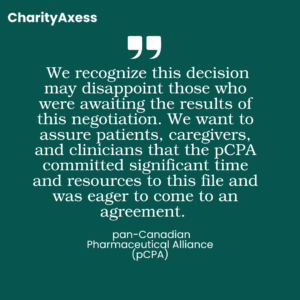
“We recognize this decision may disappoint those who were awaiting the results of this negotiation,” the pCPA stated. “We want to assure patients, caregivers, and clinicians that the pCPA committed significant time and resources to this file and was eager to come to an agreement.”
The organization emphasized that negotiations are based on clinical evidence and cost-effectiveness assessments provided by Canada’s Drug Agency and Québec’s Institut national d’excellence en santé et en services sociaux (INESSS).
“Negotiations are always evidence-informed and value-based,” the pCPA stated. “During the negotiation, AbbVie’s offers didn’t align with the value associated with the clinical and pharmacoeconomic evidence.”
While the pCPA declined to disclose specific details due to confidentiality rules, it noted that discussions could potentially resume in the future.
“We’d welcome an opportunity to re-engage this file, which can be done through AbbVie submitting an unsolicited proposal,” the organization stated. “Our team would be ready and available to respond should we receive a submission.”
The decision has sparked frustration among patients, caregivers, and nonprofit organizations advocating for better cancer treatments and greater investment in ovarian cancer research.
In OVDdialogue, Ovarian Cancer Canada’s peer support online forum, several women expressed fear, frustration, and disappointment following news that negotiations had collapsed.
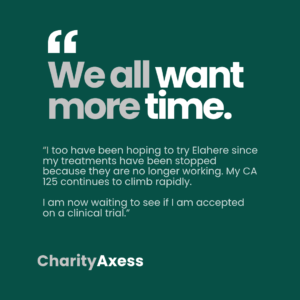
“I too have been hoping to try Elahere since my treatments have been stopped because they are no longer working,” wrote one patient identified as “PAT.” “My CA 125 continues to climb rapidly. I am now waiting to see if I am accepted on a clinical trial. We all want more time.”
Another forum member questioned how patients and advocates could pressure stakeholders to return to negotiations.
“What exactly can we do to use our collective voices to raise attention and get both parties back to the table?” wrote a user identified as “ALWAYSLEARNING.” “Do we target pCPA? Their leadership team? AbbVie? Our premiers? Prime Minister? Health Canada?”
A third user, “Meinvan,” raised concerns about healthcare equity and government spending priorities.
“I believe everyone should have equal treatment no matter their geography,” the user wrote. “Government spend billions on pipelines, fifa security yet we can't fund a medication that may give cancer fighters more hope, more time.”
What Options Do Canadian Patients Have Left?
With public reimbursement off the table, Canadian patients are left to navigate fragmented alternative pathways. For those seeking access to Elahere, hope now rests on a handful of limited options:
Private Health Insurance
Patients with robust private or employer-sponsored insurance plans may be able to apply for exceptional coverage, although out-of-pocket copays can still remain substantial.
The “AbbVie Care” Patient Support Program (PSP)
AbbVie operates a managed patient support ecosystem. In the wake of failed pCPA negotiations, manufacturers often rely on these internal programs to help patients navigate private insurance appeals or coordinate financial bridging mechanisms.
Compassionate Access and Humanitarian Programs
In severe or exceptional cases, clinicians may advocate for compassionate supply directly from the manufacturer. However, these programs are tightly controlled and remain entirely at the discretion of the pharmaceutical company.
The closure of the pCPA file leaves a bitter reality for many Canadian oncology advocates and patients. While the science to treat a devastating disease now exists, the mechanics of Canadian drug pricing mean access may ultimately depend on the strength of a patient’s private insurance coverage or the willingness of a manufacturer to provide support outside the public system.
Written by: Kamarah Curling, MBA
This article is available in both English and French.
Frequently Asked Questions
What is Elahere?
Elahere, also known by its generic name mirvetuximab soravtansine, is a targeted ovarian cancer drug designed for patients with platinum-resistant ovarian cancer whose tumors express folate receptor-alpha (FRα). The treatment works by delivering cancer-fighting medication directly into cancer cells while limiting damage to surrounding healthy tissue.
Why is Elahere considered important for ovarian cancer patients in Canada?
Elahere is significant because it became the first new ovarian cancer treatment approved in Canada in more than a decade for this patient group. Many women with platinum-resistant ovarian cancer have limited treatment options once standard chemotherapy stops working.
Is Elahere publicly funded in Canada?
No. Although Health Canada approved Elahere in 2025, negotiations between AbbVie and the pan-Canadian Pharmaceutical Alliance (pCPA) ended without an agreement in May 2026. As a result, the drug is currently not expected to be added to provincial public drug formularies.
Why did negotiations for Elahere funding fail in Canada?
According to Canada’s Drug Agency, Elahere did not meet cost-effectiveness thresholds at its current price. The agency recommended that the drug would require a price reduction of more than 80% before public reimbursement could be considered cost-effective. Negotiations between AbbVie and the pCPA ultimately broke down over pricing and value assessments.
What is platinum-resistant ovarian cancer?
Platinum-resistant ovarian cancer refers to ovarian cancer that no longer responds effectively to platinum-based chemotherapy treatments. This form of the disease is often more aggressive and associated with fewer available treatment options.
Can Canadian patients still access Elahere?
Some patients may still be able to access Elahere through private insurance, patient support programs, compassionate access pathways, or clinical trials. However, access can vary significantly depending on individual circumstances and financial coverage.
What is folate receptor-alpha (FRα)?
Folate receptor-alpha (FRα) is a protein found on the surface of certain ovarian cancer cells. Elahere specifically targets tumors with high levels of this protein, which helps deliver treatment directly to cancer cells.
Has Elahere been approved in other countries?
Yes. The United States Food and Drug Administration (FDA) first granted accelerated approval to Elahere in 2022 before later granting full approval in 2024. Canada approved the drug in 2025.
What is the pan-Canadian Pharmaceutical Alliance (pCPA)?
The pan-Canadian Pharmaceutical Alliance (pCPA) is an organization that negotiates drug prices on behalf of Canada’s provinces and territories. Its goal is to help public drug plans achieve better value and lower costs for medications.
Could Elahere negotiations reopen in the future?
Possibly. The pCPA stated that negotiations could resume if AbbVie submits a new proposal in the future.